NIS 2 status in Belgium
What the directive requires, how Belgium transposes it, and where the CCB sits inside the picture.




Overview
The NIS 2 directive is the EU layer. It binds every member state, including Belgium, with one cybersecurity floor for essential and important entities. Belgium must put that floor into Belgian law and run a supervision regime under it.
Belgium transposes NIS 2 through the Law of 26 April 2024 establishing a framework for the cybersecurity of networks and information systems of general interest for public security. The law was published in the Moniteur belge / Belgisch Staatsblad on 17 May 2024 and entered into force on 18 October 2024, alongside a Royal Decree that fills in the operational detail. Belgium is one of the few member states that met the directive's 17 October 2024 deadline.
The Centre for Cybersecurity Belgium (CCB) is the lead competent authority. CERT.be operates as a service inside the CCB. Registration runs through the Safeonweb@work portal. Sector authorities stay in the loop where they exist: the National Bank of Belgium (NBB) for the finance sector, where DORA acts as lex specialis, and BIPT for digital infrastructure (except trust services) and postal services.
EU directive
Directive (EU) 2022/2555 (NIS 2)
The EU-wide cybersecurity directive. Sets the obligations every member state must transpose, including the size and sector tests for essential and important entities.
EU implementation
Commission Implementing Regulation (EU) 2024/2690
Technical and methodological requirements for DNS providers, TLD registries, cloud, data centre and CDN providers, managed (security) service providers, online marketplaces, search engines, social networks and trust service providers. Directly applicable in Belgium without national transposition.
Belgian transposition
Law of 26 April 2024 (NIS 2 law)
The Belgian NIS 2 transposition, published in the Moniteur belge on 17 May 2024 and in force from 18 October 2024. The implementing Royal Decree of 9 June 2024 and CCB guidance fill in the operational detail. The law repeals the Law of 7 April 2019 (the Belgian NIS 1 transposition).
Law of 26 April 2024
Carries the NIS 2 obligations into Belgian law. Defines essential and important entities, the supervision powers of the CCB, incident reporting duties, and sanctions. Most operational detail sits in the Royal Decree of 9 June 2024 and in CCB guidance.
CCB as supervisor, CERT.be as CSIRT
The Centre for Cybersecurity Belgium runs supervision, audits and sanctions. CERT.be operates inside the CCB as the national CSIRT for incident handling. Safeonweb@work is the public-facing portal for registration and guidance.
Registration and reporting
DNS providers, TLD registries, domain registration services, cloud, data centre and CDN providers, managed (security) service providers, online marketplaces, search engines and social networks had to register on Safeonweb@work by 18 December 2024. All other essential and important entities had to register by 18 March 2025. Significant incidents are notified via notif.safeonweb.be on the directive's cadence: 24h early warning, 72h notification, one-month final report.
Local law applies inside Belgium
Operations on Belgian territory follow the Belgian transposition. A German managing director running a Belgian subsidiary reads the Law of 26 April 2024 for that subsidiary, not the German BSIG. The directive obligations are the same; the procedure, the portal and the sanctions live in Belgian law.
Belgium cannot go below the EU floor
The directive is a minimum harmonisation instrument. Belgium can go stricter, and in practice does so via the CyberFundamentals framework and the Royal Decree. It cannot drop below the directive on essential and important entity duties, incident reporting deadlines or management body accountability.
CCB
Centre for Cybersecurity Belgium, the national cybersecurity authority under the Prime Minister. Lead competent authority for NIS 2: supervision, audits, sanctions, and the Safeonweb@work registration portal. Publishes the CyberFundamentals framework. Entities that undergo a periodic conformity assessment against CyberFundamentals or ISO/IEC 27001 are presumed to meet the NIS 2 risk-management measures.
CERT.be
The national Computer Security Incident Response Team. Operates as a service inside the CCB rather than as a separate agency. Handles incident notifications, technical coordination, and operational cooperation with other EU CSIRTs.
ENISA
The EU cybersecurity agency. Publishes guidance, manages the European vulnerability database, and supports cross-border coordination. Not a supervisor for Belgian entities; the CCB is.
Belgium is on the same timeline as Germany.
Belgium met the 17 October 2024 deadline. The Law of 26 April 2024 was published in the Moniteur belge on 17 May 2024 and entered into force on 18 October 2024, with registration deadlines that already passed in December 2024 and March 2025. Germany transposed later: its new BSIG has applied since 6 December 2025. A German parent's timetable says nothing about the Belgian subsidiary. Its supervisor is active, and a missed registration is overdue.
There is no functioning registration portal yet.
Safeonweb@work is live and operational. DNS, TLD, domain registration, cloud, data centre, CDN, managed (security) service, marketplace, search engine and social network providers had to register by 18 December 2024; all other essential and important entities by 18 March 2025. Late registration is a compliance gap that the CCB can act on, and registration data must be kept up to date under Article 3(4) of the directive.
Only the sectors that already had a NIS 1 regulator are in scope.
NIS 2 widens the perimeter well beyond the NIS 1 OES list. New sectors include public administrations, manufacturing, food, postal and courier services, waste management and chemicals, among others. The size test caps at medium and large enterprises by default, but small entities can be captured where they are sole providers or where the law adds them. The applicability check has to be done case by case.
Belgium is the rare EU country where NIS 2 is operational, not theoretical. The CCB is staffed, the registration portal works, the Royal Decree is in force, and the CyberFundamentals framework gives entities a concrete implementation path that, with a periodic conformity assessment, leads to a presumption of conformity. Belgian operators that have not registered yet are not ahead of the curve, they are behind it.
The practical move is the same as everywhere else in the EU: confirm scope under the directive, register on Safeonweb@work, set up the four continuous obligations (registration upkeep, incident reporting, supply chain risk, management body oversight), and document the minimum. The CyFun framework helps with the substantive controls, but it does not replace documenting the NIS 2 measures themselves.
- Directive (EU) 2022/2555 (NIS 2): EUR-Lex
- Commission Implementing Regulation (EU) 2024/2690
- Law of 26 April 2024 establishing a framework for the cybersecurity of networks and information systems of general interest for public security: Moniteur belge / Belgisch Staatsblad, 17 May 2024
- Royal Decree of 9 June 2024 implementing the NIS 2 law: Moniteur belge / Belgisch Staatsblad
- Centre for Cybersecurity Belgium (CCB): ccb.belgium.be
- Safeonweb@work: atwork.safeonweb.be (NIS 2 registration portal)
- CERT.be: national CSIRT, operating inside the CCB
- CyberFundamentals (CyFun) framework: CCB
In practice
What the national law changes, and what it doesn't
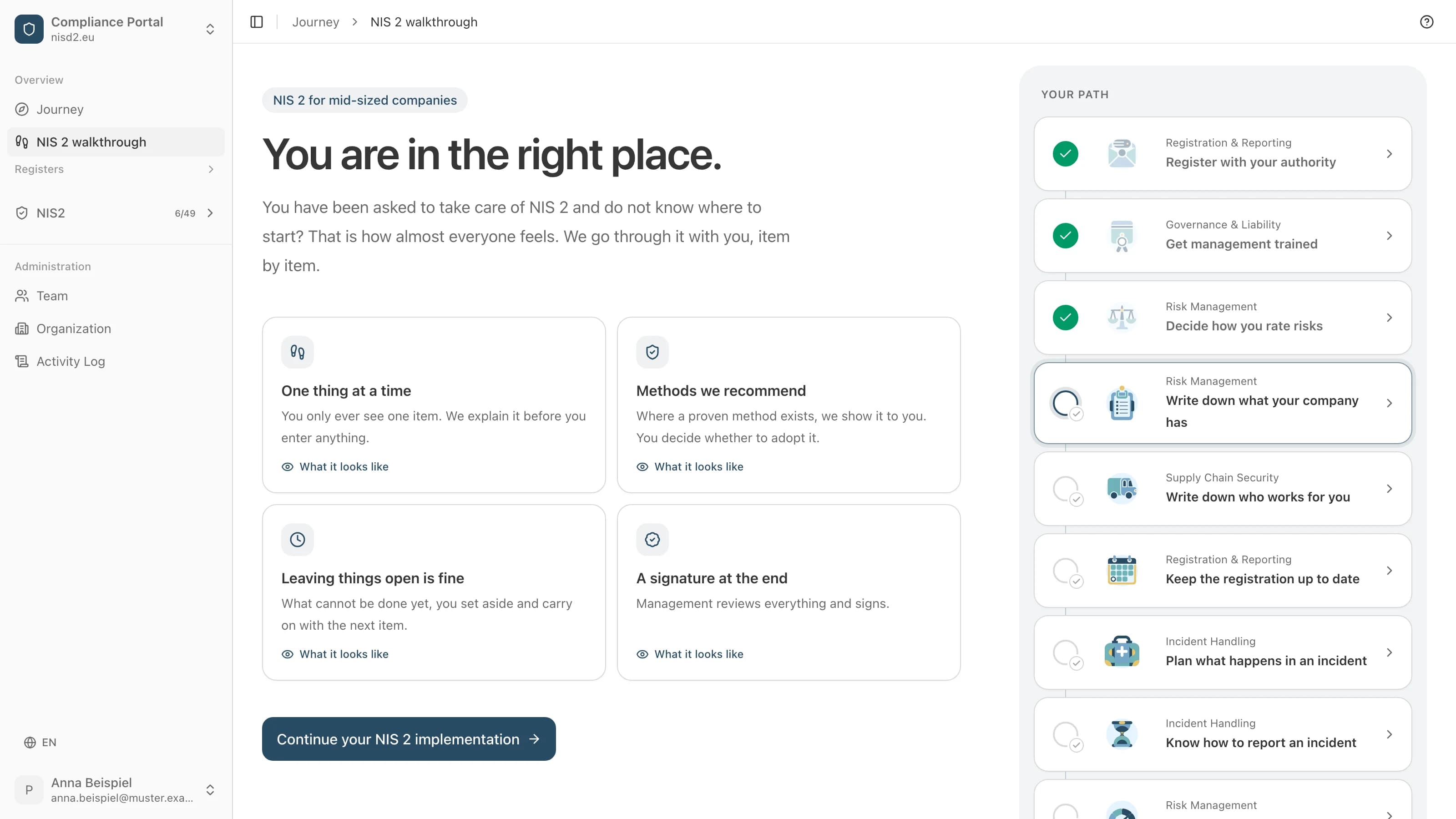
The national law decides, among other things, where you register and whom you report incidents to. The measures themselves start from the same minimum list in every member state (Art. 21 NIS 2). The walkthrough takes you through them one step at a time:

Risk Management
Write down what your company has
A list of the processes, software and devices you work with.

Incident Handling
Plan what happens in an incident
Who decides, whom you call, how you reach each other.

Effectiveness Assessment
Record the management review
Management checks whether the measures work and approves your documents.
Been asked to handle NIS2?
In the end you have everything in one document: what is done, what is still open, and your management's approval with name and date. The app writes the texts.