Cyber Resilience Act with AI: what an MCP server can do for manufacturers
Since 11 September 2026 the Cyber Resilience Act has obliged manufacturers to report actively exploited vulnerabilities and severe incidents; from 11 December 2027 they must also keep a list of software components (SBOM). An AI assistant can maintain the SBOM and draft reports. The manufacturer decides whether to report. The nisd2.eu MCP server serves buyers, in the NIS 2 walkthrough.



What does the Cyber Resilience Act require of manufacturers?
The Cyber Resilience Act, Regulation (EU) 2024/2847, covers products with digital elements: software and hardware, together with the data processing at a distance that the manufacturer develops for them and without which the product could not perform one of its functions (Art. 3(1) and (2)).
Its duties fall mainly on the manufacturer. That is whoever develops or manufactures such products, or has them developed or manufactured, and markets them under its own name or trademark (Art. 3(13)). One example is a company that sells its own software or a connected device.
For vulnerability handling, Annex I Part II lists eight duties, among them: document components and vulnerabilities, remediate without delay, disclose fixed vulnerabilities and give a contact address for reports. This holds for the support period, as a rule at least five years (Art. 13(8)).
Art. 3(1), (2) and (13), Art. 13(8), Annex I Part II CRA
What is an SBOM under the CRA, and who gets it?
The SBOM (software bill of materials) is a formal record of the components in a product's software and their supply chain relationships (Art. 3(39)). The manufacturer draws it up in a commonly used, machine-readable format covering at the very least the top-level dependencies (Annex I Part II(1)).
The Regulation names no particular format; the Commission may set the format and elements by implementing acts (Art. 13(24)). The SBOM is part of the technical documentation, which the manufacturer keeps available for at least ten years (Art. 13(13), Annex VII).
The manufacturer does not have to publish it. Whether users get it is the manufacturer's choice (Annex II(9)). A market surveillance authority receives it on a reasoned request, where it needs it to check compliance (Annex VII(8)).
Art. 3(39), Art. 13(13) and (24), Annex I Part II(1), Annex II(9), Annex VII CRA
Which reporting deadlines apply since 11 September 2026?
Manufacturers report actively exploited vulnerabilities and severe incidents affecting the security of the product, including for products already on the market before 11 December 2027 (Art. 69(3)). A vulnerability is actively exploited when there is reliable evidence that a malicious actor has exploited it in a system without the owner's permission (Art. 3(42)).
For a vulnerability: an early warning within 24 hours of the manufacturer becoming aware of it and a notification within 72 hours. The final report follows no later than 14 days after a corrective or mitigating measure is available. For an incident the same 24 and 72 hours apply, and the final report follows within one month of the notification.
Reports go through ENISA's single reporting platform, simultaneously to the CSIRT designated as coordinator and to ENISA (Art. 14(1) and (7), Art. 16). A CSIRT is a computer security incident response team designated by a Member State; as a rule it is the one in the country of the manufacturer's main establishment. The manufacturer also informs the impacted users (Art. 14(8)).
Art. 3(42), Art. 14, Art. 16, Art. 69(3) CRA
What an AI assistant can do for manufacturers
MCP (Model Context Protocol) is an open standard that lets an AI assistant such as Claude or Copilot use another program. An MCP server is a program's connection for it. For the work below the assistant needs access to your development tools, for example through their MCP servers where the vendor offers one.
An assistant that works in the place where your source code is kept (the code repository) can have the SBOM generated for every new version and check that it matches what you ship. Our course “CRA SBOM Fundamentals” shows which formats exist and which tools generate an SBOM.
It matches the SBOM against published vulnerabilities, for example in ENISA's European vulnerability database, and prepares the hits for a person. It drafts the notes on fixed vulnerabilities (Annex I Part II(4)) and the message to the maintainer of an affected component (Art. 13(6)).
For a report it prepares what Art. 14(2) lists: the product concerned, the nature of the exploit, the measures taken and what users can do themselves.
What the manufacturer decides itself
The Regulation addresses these duties to the manufacturer. It does not say who in the company decides.
The EU declaration of conformity, a document the manufacturer draws up, states that meeting the requirements of Annex I has been demonstrated. With it the manufacturer assumes responsibility for its product (Art. 28(1) and (4)). With the CE marking on the product it indicates that the product and its processes meet those requirements (Art. 3(31)).
Several steps are judgements: whether the evidence of exploitation is reliable, how long the support period is, and whether information on a fixed vulnerability is published later in duly justified cases. An assistant supplies the material. We recommend that a person who may act for the manufacturer decides.
Art. 3(31), Art. 13(8), Art. 28(1) and (4), Annex I Part II(4) CRA
What nisd2.eu covers here
The nisd2.eu MCP server fills in only the NIS 2 walkthrough; once an admin allows it, it also reads the company's records for someone who may export, the vulnerability and patch registers included. It keeps no SBOM, reports nothing to ENISA and records no CRA obligations.
It helps on the buyer's side. NIS 2 requires security when you acquire your IT, including vulnerability handling (Art. 21(2)(e)). The CRA gives you facts to ask for. For products placed on the market from 11 December 2027, the manufacturer states the end of the support period at the time of purchase, at least month and year (Art. 13(19)). The product also comes with a point of contact for reporting vulnerabilities (Annex II(2)).
Art. 21(2)(e) NIS 2 · Art. 13(19), Annex II(2) CRA
How the walkthrough does it
In the NIS 2 walkthrough you are on the buyer's side: you record what you require of manufacturers and suppliers.
6.3 Write the rules for buying, updates and vulnerabilities: the section “When buying” already says you check whether and for how long a provider supplies security updates. An assistant can add under “Further rules” that you ask for the end of the support period. You read the rules; management approves them at the end of the walkthrough.
5.2 Record what you have agreed with your suppliers: it ticks for each supplier whether the contract settles security requirements and reporting incidents to you. You check each row.
2.2 Write down what your company has: the list names each program with its provider. It lets you see which vulnerability notices concern you; 6.3 shows where such notices appear.
7.3 Record the management review: a supplier rated high or very high risk whose contract settles neither security nor incidents appears under “What the answers still leave open”. There you set who takes care of it and by when.
Common questions
When does the Cyber Resilience Act apply?
The Regulation has been in force since 10 December 2024. The reporting obligations in Art. 14 have applied since 11 September 2026, the rules on notifying the bodies that assess products (Chapter IV) since 11 June 2026, and everything else applies from 11 December 2027 (Art. 71(2)).
Does the CRA apply to software as a service?
Only where a cloud solution is a product's data processing at a distance, such as controlling a smart home device remotely. Cloud services designed and developed outside the responsibility of a product's manufacturer are not covered by the CRA. Recital 12 places software as a service under the NIS 2 Directive, for providers of medium size and above.
Does the CRA affect companies that only buy software?
The duties lie mainly with manufacturers, authorised representatives, importers and distributors. Anyone who substantially modifies a product and makes it available on the market counts as its manufacturer (Art. 22(1)). In our reading, a company that only buys and uses software has no CRA duties of its own.
Can AI submit the CRA report to ENISA?
The Regulation does not say who in the company reports. It obliges the manufacturer, and the early warning is due within 24 hours. We recommend that an assistant prepares the draft and a person checks and submits it.
How do the CRA and NIS 2 relate?
NIS 2 governs the cybersecurity of entities, the CRA that of products; for the term incident, the CRA refers to NIS 2 (Art. 3(43)). If a NIS 2 company is itself a manufacturer, both apply. If it buys products, the CRA's information helps it with its supply chain.
Read next
- Building a NIS2 supplier register with AIFrom your list of creditors and contracts, the assistant adds one line per supplier in 5.1 and ticks in 5.2 what is agreed. What you check afterwards.
- NIS 2 vulnerability management under Art. 21(2)(e) and CIR §6.10Identify, assess, treat and coordinate disclosure of vulnerabilities. What CIR §6.10 asks of the digital providers it covers.
- Compliance and GRC MCP servers comparedWhat GRC vendors' MCP servers may read, write and delete, who switches them on and what stays with a person. As of October 2026.
Sources
- Regulation (EU) 2024/2847 (Cyber Resilience Act), Art. 3, 13, 14, 16, 22, 28, 69 and 71, recital 12, Annexes I, II and VII, EUR-Lex (CELEX 32024R2847)
- Directive (EU) 2022/2555 (NIS 2), Art. 21, EUR-Lex (CELEX 32022L2555)
- nisd2.eu course “CRA SBOM Fundamentals”, open-isms, courses/cra-sbom, github.com/NISD2/open-isms
- open-isms, lib/durchgang/nis2.ts, lib/durchgang/gaps.ts and messages/durchgang (items 2.2, 5.2, 6.3, 7.3), github.com/NISD2/open-isms
- open-isms, lib/mcp/walk.ts and content/docs/self-hosting/mcp.md (what an assistant fills in), github.com/NISD2/open-isms
In practice
Where this comes up in the walkthrough
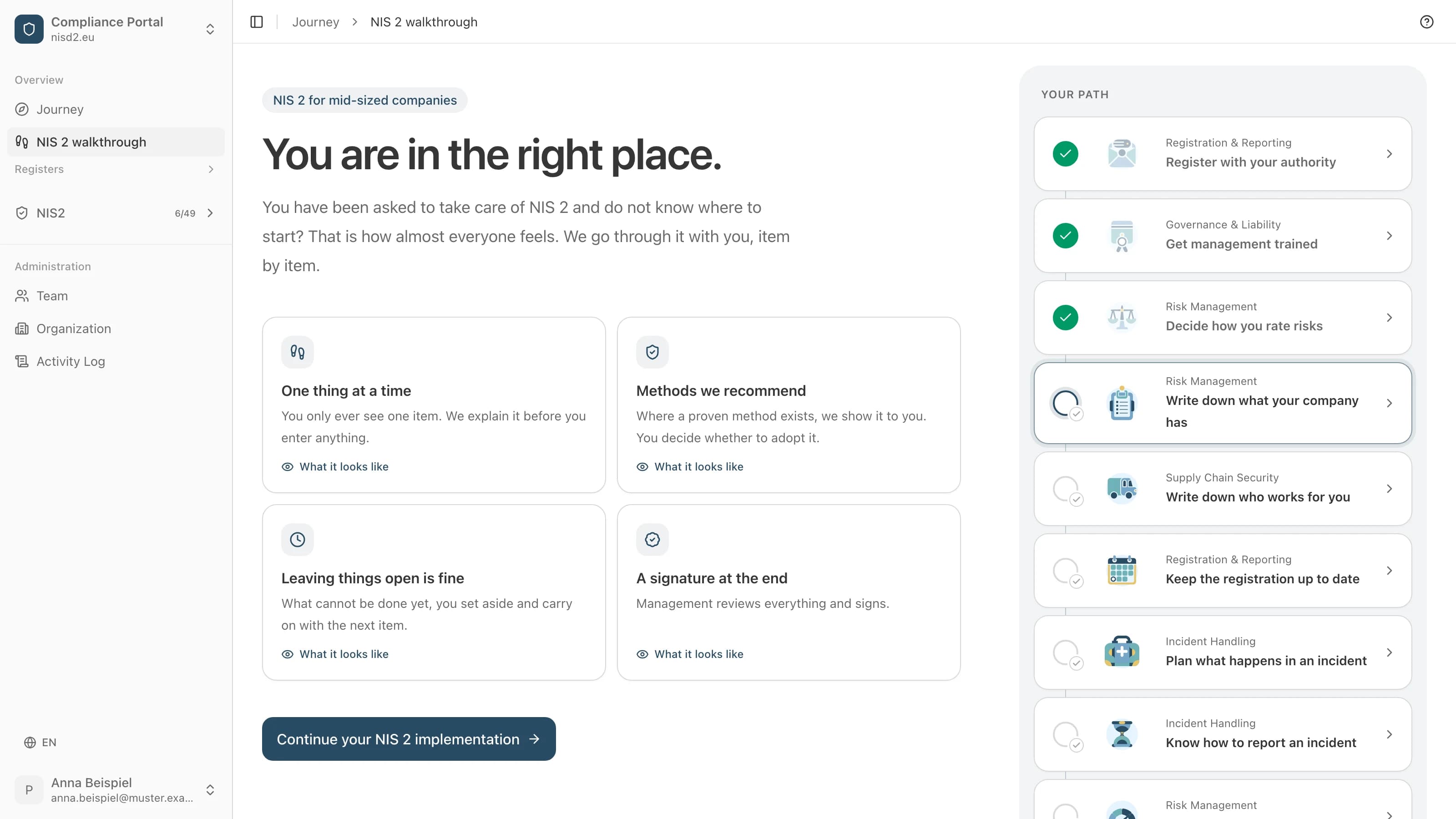
The walkthrough turns this into steps you fill in, with the law explained beside each one. Open a step to see its screen, filled in for a made-up company.
Procurement & Development
Write the rules for buying, updates and vulnerabilities
What you check when buying, how updates arrive and who closes gaps.

Supply Chain Security
Record what you have agreed with your suppliers
For each supplier: what does the contract say about security?
What the walkthrough costs
€4,800 net a year, plus VAT
30 days money backBy invoice, due in 30 days. Cancel within the first 30 days, before the first export or sign-off: invoice cancelled or money back.
Guided NIS 2 implementation, step by step
A history of changes and sign-offs to show your regulator
Deadlines and reminders for each requirement
Security questionnaire for your suppliers
Export to PDF or CSV at any time
Been asked to handle NIS2?
In the end you have everything in one document: what is done, what is still open, and your management's approval with name and date. The app writes the texts.