Creating a record of processing activities: what Art. 30 GDPR requires
The record of processing activities (ROPA) describes every processing of personal data in your company: purpose, data subjects, categories of data, recipients, third countries and, where possible, erasure time limits and TOMs (Art. 30(1) GDPR). In the view of Germany's data protection conference, the exemption for fewer than 250 employees rarely applies.

What goes into a record of processing activities?
Each controller maintains a record of all processing activities under its responsibility (Art. 30(1) GDPR). The controller is your company, because it determines the purposes and means of the processing (Art. 4(7)).
It gives the name and contact details of your company and of any data protection officer. For each activity it states the purposes, the categories of data subjects and of personal data, and the categories of recipients. It adds transfers to third countries, naming the country, and, where possible, the time limits for erasure and a general description of the TOMs under Art. 32(1).
The record is kept in writing, which includes electronic form (Art. 30(3)). You make it available to the supervisory authority on request (Art. 30(4)); you do not have to publish it. If your company itself processes data on behalf of others, it keeps a second record for that under Art. 30(2).
Art. 4(7) · Art. 30(1) to (4) GDPR
Does the duty apply under 250 employees?
Art. 30(5) exempts organisations employing fewer than 250 persons “unless the processing it carries out is likely to result in a risk to the rights and freedoms of data subjects, the processing is not occasional, or the processing includes special categories of data”, such as health data, or data relating to criminal convictions and offences.
One of these conditions is enough. The DSK is the conference of Germany's federal and state data protection authorities. It names payroll and customer data management as processing that is not occasional, and it expects the exemption to apply only rarely.
On that reading, a company that runs payroll or maintains customer data regularly is not exempt. The German wording of paragraph 5 was corrected in 2016 (OJ L 314, 22.11.2016), so German quotes of the original version word the exemption differently.
Art. 30(5) GDPR
What is a processing activity? An example
The DSK generally treats a processing activity as a business process at a suitable level of abstraction. Each new purpose is a separate activity. Name it after its purpose, such as “payroll and salary accounting”. For the software, the DSK template has an optional field, “Name des eingesetzten Verfahrens” (name of the procedure used).
A made-up example: Muster Metall GmbH has 80 employees. Its entry “payroll” gives the purpose as paying wages, the data subjects as employees, and the data as master data, bank details and tax attributes. Recipients are the tax office, social insurance bodies and banks, plus the payroll software vendor where it processes the data in its cloud.
Under third countries it says “none”, because the DSK advises stating that explicitly too. The erasure time limit names the legal provision and when the period starts. For TOMs, the entry refers to the cryptography policy and the staff, access and asset policy from the NIS 2 walkthrough. The DSK expressly allows such references to information security documents.
Which mistakes to avoid in the record
A record that only lists software, such as “Microsoft 365” or “DATEV”, describes tools instead of purposes. One program often serves several activities, and one activity often uses several programs.
An entry such as “statutory retention periods” is a general reference, and in the DSK's view that is not enough: it asks for precise information. The European Data Protection Board (EDPB) recommends in its February 2026 report that the record state whether a legal obligation to retain the data exists.
A record goes out of date with every new program and every new service provider. The DSK recommends documenting changes and keeping that documentation for one year.
With an AI assistant: what it can prepare for the record
An AI assistant such as Claude, ChatGPT or Copilot can draft entries from your documents: your list of processes and software, suppliers and contracts. Through MCP (Model Context Protocol), an open standard, it also reads the NIS 2 walkthrough's lists. It covers the person's areas, and all records if an admin allows it and they may export.
Anything your documents do not state, such as a legal basis or an erasure time limit, is a suggestion in the draft. Whether an entry is correct and which time limit applies is for your company to decide as controller, with your data protection officer where one is designated.
Whatever you hand the assistant, such as payroll lists, its vendor processes too. Where the vendor acts as a processor, a contract under Art. 28(3) GDPR is required. A GDPR walkthrough on nisd2.eu is in the works, with the same MCP server as the NIS 2 walkthrough.
A request to the assistant can read like this:
Use get_walkthrough to read items 2.2 and 5.1. For every ticked process that involves personal data, draft an entry for the record of processing activities under Art. 30(1) GDPR, with purpose, data subjects, categories of data, recipients, third country, erasure time limit and TOMs. Flag every field the records do not state and leave it empty. Do not enter anything in the walkthrough.What the NIS 2 walkthrough already records
Item 2.2 records processes, software and their vendors: in our reading, source material for the record, but not a record under Art. 30 GDPR.
2.2 Write down what your company has, screen “What your company does every day”: the processes you tick, such as “HR and payroll administration”. Each process involving personal data becomes one or more processing activities. The walkthrough does not ask for purposes, categories of data or erasure time limits.
2.2, “Software for customers, staff and money” and “Which software exactly, and from whom?”: each program with its vendor, such as the payroll software. That fits the optional field “Name des eingesetzten Verfahrens” in the DSK template. Whether a vendor processes data on your behalf or moves it to a third country is not recorded there.
On the “Export” page, “Everything in one document” contains the sections “Assets” and “Suppliers”. Admins, reviewers and management save it as a PDF and pass it to whoever handles your data protection.
That person adds purpose, data subjects, categories of data, recipients, third country, erasure time limit and TOMs per activity. If the list in 2.2 changes, the record does not change with it: compare the two whenever a program is added.
Common questions
Is there a template for the record of processing activities?
Yes. The DSK publishes a template for controllers under Art. 30(1) GDPR on datenschutzkonferenz-online.de, dated February 2018, with notes on filling it in. It is in German and has a cover sheet for your company's details and one form per processing activity with the required information.
Who has to keep the record of processing activities?
The controller, meaning your company (Art. 30(1)). A data protection officer informs, advises and monitors compliance (Art. 39(1)). They can look after the record, but the duty stays with the company; decide internally who maintains it.
Is a NIS 2 asset list the same as a record of processing activities?
No. The list in 2.2 says what your company works with, so you can protect it. The Art. 30 record describes, per purpose, whose data you process, where it goes and when it is erased. One list helps you build the other.
How often should the record of processing activities be updated?
Art. 30 sets no interval. The record covers all processing activities under your responsibility, which includes new ones. Update it whenever a new purpose, program or service provider comes in, and document the change.
Read next
- Data processing agreement (DPA): when you need oneWhen a provider is a processor, what Art. 28(3) GDPR puts in the contract and what you check afterwards.
- GDPR TOMs: technical and organisational measuresWhat Art. 32 GDPR means by technical and organisational measures, how to pick the right level and how to document the TOMs.
- GDPR with an AI assistant and MCP: what works, what does notWhat an assistant can prepare for records, TOMs, contracts and breaches, what the controller decides, and what the NIS 2 walkthrough does not contain.
- Building an asset inventory for NIS2 with AIFrom an inventory, licence list or CMDB export, an AI assistant fills the lists in item 2.2. What belongs in it under NIS 2, and what you check yourself.
Sources
- Regulation (EU) 2016/679 (GDPR), Art. 4(7), Art. 28, 30 and 39, with the German corrigenda to Art. 30(5) (OJ L 314, 22.11.2016) and Art. 30(2) (OJ L 74, 4.3.2021), CELEX 32016R0679, publications.europa.eu
- Datenschutzkonferenz (DSK), Kurzpapier Nr. 1 on the record of processing activities, as of 17.12.2018, datenschutzkonferenz-online.de
- DSK, Hinweise zum Verzeichnis von Verarbeitungstätigkeiten and template for controllers under Art. 30(1), both February 2018, datenschutzkonferenz-online.de
- European Data Protection Board (EDPB), 2025 Coordinated Enforcement Action, Implementation of the right to erasure by controllers, adopted 10 February 2026, section 4.2.5, edpb.europa.eu
- open-isms, lib/durchgang/nis2.ts (item 2.2), lib/asset-inventory/catalog.ts, lib/mcp/tools.ts, messages/durchgang and messages/export, github.com/NISD2/open-isms
In practice
Where this comes up in the walkthrough
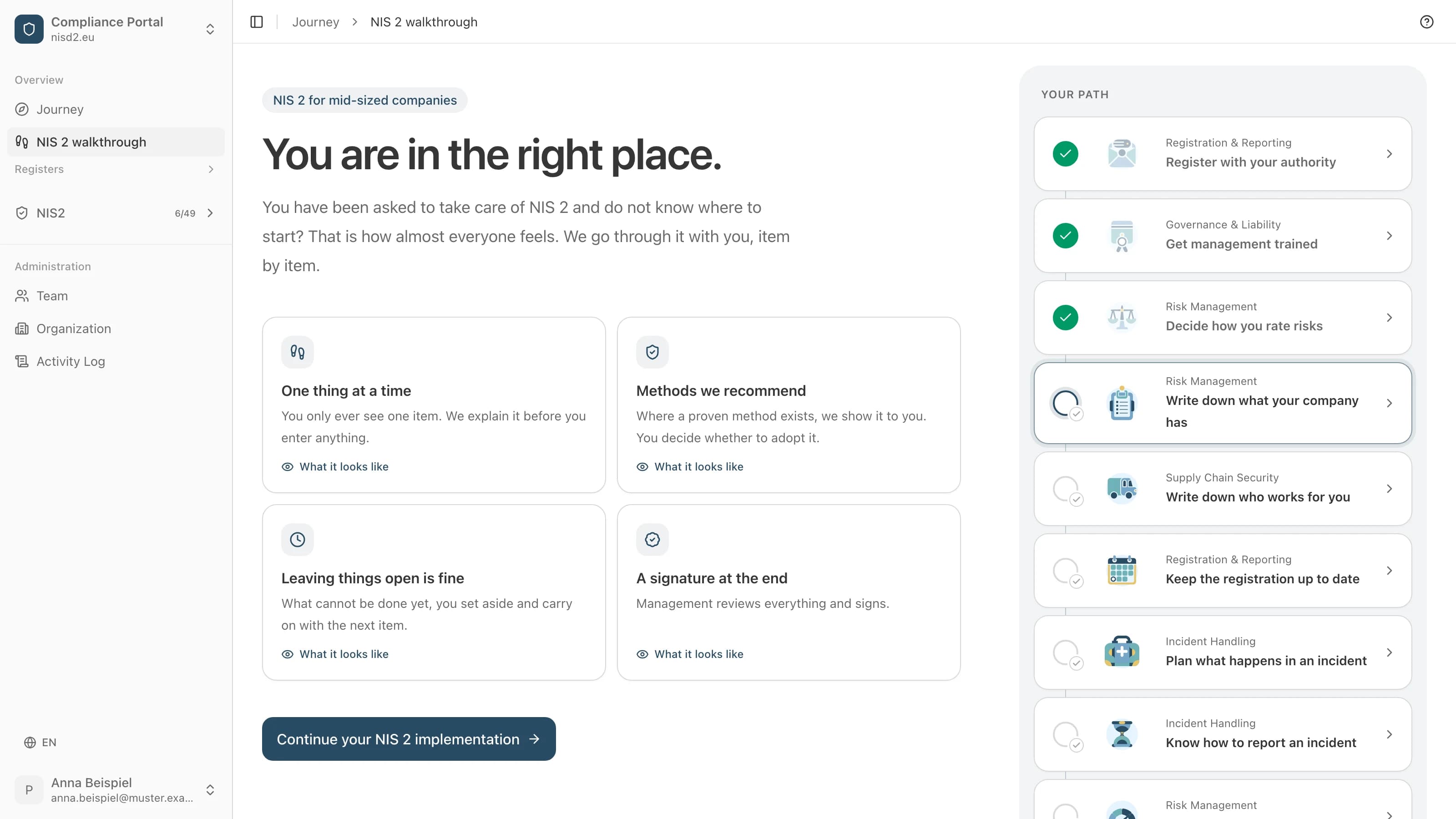
The walkthrough turns this into steps you fill in, with the law explained beside each one. Open a step to see its screen, filled in for a made-up company.

Risk Management
Write down what your company has
A list of the processes, software and devices you work with.
In the works
The GDPR walkthrough
After the NIS 2 walkthrough, nisd2.eu is building a GDPR walkthrough. It will work with the same MCP server, so your own AI assistant can fill it in too. We are not naming a date yet. Join the waitlist and we will write to you once it is ready.
With a free account on nisd2.eu. You can leave the waitlist at any time on the same page.
Been asked to handle NIS2?
In the end you have everything in one document: what is done, what is still open, and your management's approval with name and date. The app writes the texts.